How to Memorize Preflop Ranges Without Studying Charts for Hours
- Why charts are hard to memorize
- Memorize preflop ranges by hand class
- Learn ranges by position comparison
- Use anchor hands to remember each range
- Active recall beats passive chart reading
- Use pattern rules to reduce the amount you need to memorize
- Make your study routine short and repeatable
- Drill ranges in the order you actually use them
- Turn charts into a poker range trainer, not a wallpaper
- Common mistakes when trying to memorize ranges
- A simple example: how to learn one opening range
- External reference for math and range thinking
The better approach is to as patterns, not as isolated hand-by-hand facts. Instead of brute-force memorization, you can build a simple mental system around position, hand classes, and short daily drills. That is how most players actually improve their : by turning charts into decisions they can recall quickly at the table.
This guide will show you how to without wasting entire study sessions on passive reading. You will learn a practical framework for , active recall, and fast drills that fit into a normal routine.
Why charts are hard to memorize
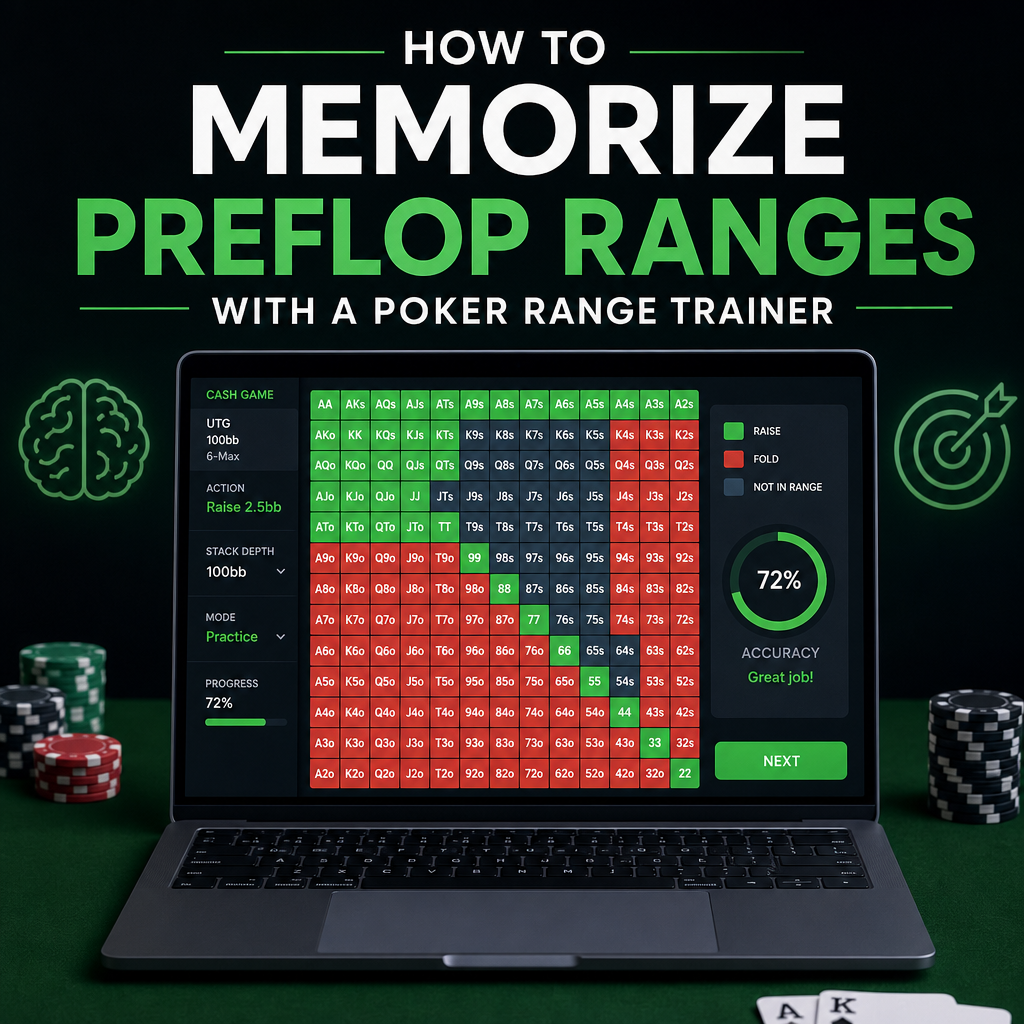
A preflop chart is useful because it gives exact answers, but the human brain does not naturally store information in grid form. It stores patterns.
If you try to memorize every hand one by one, you end up with disconnected facts like:
- AJo opens from here
- ATo folds there
- KJo sometimes opens
- QTs is in one spot but not another
That creates fatigue fast. The solution is to group hands into classes and understand why a range changes from one position to another.
When you learn ranges this way, you stop seeing 169 separate hand combinations and start seeing a few repeatable themes:
- Premium hands always appear
- Suited hands gain value in position
- Offsuit broadways become more playable later
- Small pairs and suited connectors depend heavily on depth and position
Once you understand those patterns, charts become easier to remember because they feel logical instead of random. That is the first step to memorize preflop ranges in a way that lasts.
Memorize preflop ranges by hand class
The fastest way to memorize preflop ranges is to organize them by hand class. Instead of thinking in one combo at a time, think in families.
Core hand classes to learn
Focus on these groups first:
- Premium pairs: AA, KK, QQ, JJ, TT
- Mid and small pairs: 99 through 22
- Strong broadways: AK, AQ, AJ, KQ, KJ, QJ
- Suited broadways: AQs, ATs, KQs, KJs, QJs, JTs
- Suited aces: A5s through A2s, plus stronger suited aces
- Suited connectors: T9s, 98s, 87s, 76s, etc.
- Offsuit broadways: AKo, AQo, AJo, KQo, sometimes KJo and QJo
This structure helps you remember ranges as layers. For example, when your opening range gets wider in later position, the first hands to enter are usually:
- More suited aces
- More suited broadways
- More offsuit broadways
- More suited connectors
- More weak pairs or weaker offsuit hands
That progression is much easier to recall than a full grid. If you want to memorize preflop ranges efficiently, start by linking each hand class to a position and a purpose. That way, you are not memorizing isolated boxes; you are learning a system.
Learn ranges by position comparison
Position is the backbone of preflop strategy. If you compare positions side by side, the ranges start making sense quickly.
Early position is tighter
From under the gun or first in, your range is generally compact and strong. You are playing against many players behind you, so your hands need good raw equity and strong playability.
Typical early-position ideas include:
- Strong pairs
- Strong broadways
- Some suited broadways
- A few high-quality suited aces
Hands like KTo, QJo, or weak suited connectors usually do not appear here in tighter strategies.
Middle position adds selective width
As you move later, the range opens a bit. You can add hands that play well when fewer players are left to act.
This is where players begin to notice a pattern:
- More suited hands enter
- More medium-strength broadways enter
- Some weaker pairs may still open depending on structure
The key point is that your range does not expand randomly. It expands by hand quality and playability.
Late position is the widest
Cutoff and button ranges become much broader because you have position on most opponents and fewer players behind you.
This is where many beginner-to-intermediate players finally understand the logic of preflop range study:
- Hands that play okay but are not strong enough for early position now become opens
- Suited hands gain value
- Offsuit hands with decent blockers or top-pair potential become more usable
The difference between positions is one of the easiest things to study with a poker range trainer because you can test yourself repeatedly on the same spots until the pattern clicks. A good way to strengthen memorize preflop ranges is to compare one opening spot against the next instead of studying them in isolation.
Use anchor hands to remember each range
One of the best tricks for memorize preflop ranges is to build each position around anchor hands. These are the hands you absolutely know belong there. Once the anchors are stable, the rest of the range fills in naturally.
Examples of anchor hands
For an opening range, anchors might include:
- AA, KK, QQ, JJ
- AKs, AKo
- AQs, AQo
- KQs
From there, you can ask:
- Does AJs belong?
- What about KJs?
- Are 99 and 88 included?
- Is ATs in this spot?
Instead of trying to memorize the entire chart at once, you grow outward from the core. That makes review much faster and less mentally taxing.
A helpful way to think about anchors is this:
- Top of range: never in doubt
- Middle of range: pattern-based
- Bottom of range: needs repetition and testing
That bottom portion is where active recall matters most, especially when you want to memorize preflop ranges for real-game use rather than just chart recognition.
Active recall beats passive chart reading
If you want to improve poker preflop efficiently, passive reading is not enough. You need active recall, meaning you test yourself without looking first.
A simple recall process
For any spot, do this:
- Hide the chart
- Name the position
- Try to list the strongest hands first
- Add the next layer
- Check your answer against the chart
- Repeat until the structure feels automatic
This works because your brain learns more from retrieval than from recognition. Looking at a chart and saying, “Yes, that seems familiar,” is much weaker than forcing yourself to produce the range from memory.
Example recall drill
Suppose you are studying button opens.
Without looking, try to answer:
- Which pairs open?
- Which suited aces open?
- Which broadways open?
- Which suited connectors are included?
- Which offsuit broadways are too weak?
Then compare your answer to the chart and fix the gaps.
Do this for 2 to 5 minutes at a time rather than for an hour straight. Small bursts improve retention much better than marathon sessions.
Once this habit becomes routine, it is easier to memorize preflop ranges because each review session reinforces the same decision tree.
Use pattern rules to reduce the amount you need to memorize
A good poker study routine does not require you to memorize every chart from scratch. Instead, use rules that explain many hands at once.
Useful pattern rules
Suited hands are more playable than offsuit hands
This is one of the most important rules in preflop strategy. Suited hands win extra pots through flush potential and have better postflop flexibility.
Connected hands gain value with position
Hands like 98s or T9s play better when you are later in position, especially because you realize equity more efficiently.
Broadways become more valuable as positions widen
Hands like KQ and AQ are strong because they make top pairs and strong draws. Late position often includes more of them.
Blockers matter more in wider ranges
Hands with an ace or king can benefit from removing strong combinations from opponents’ ranges, especially in late-position opens and 3-bet spots.
Small pairs depend on stack depth and realization
Small pairs are often included because they can flop sets and win big pots, but they are not automatic opens in every position.
If you remember these rules, you do not need to stare at every box in a chart for hours. The chart becomes a confirmation tool, not the entire learning system. This is one of the most practical ways to memorize preflop ranges without burning out.
Make your study routine short and repeatable
The best preflop range study system is one you can do every day. Consistency matters more than intensity.
A 10-minute daily routine
Here is a simple routine you can repeat:
1. Review one position
Pick one spot, such as under the gun open or button open.
2. Recall from memory
Write down or say the range before looking.
3. Check against the chart
See what you missed or added incorrectly.
4. Group mistakes by hand class
If you missed several suited aces, that is a pattern problem, not a one-off error.
5. Repeat one more time
Immediately test the same spot again to lock it in.
This routine is short enough to sustain and strong enough to create real progress.
A weekly structure
You can also divide your week like this:
- Monday: Open ranges from early position
- Tuesday: Open ranges from middle position
- Wednesday: Button and cutoff opens
- Thursday: Blind defense
- Friday: 3-bet ranges
- Saturday: Mixed review
- Sunday: Quick self-test
This kind of schedule supports GTO range training without requiring long sessions every day.
Players who stick to this routine usually find that they memorize preflop ranges faster because the same structure appears again and again in different forms.
Drill ranges in the order you actually use them
A practical way to learn poker ranges is to study them in order of common occurrence.
Best order for learning
- Open-raise ranges
- Call/defend ranges
- 3-bet ranges
- 4-bet ranges
- Versus specific positions
Open ranges are easiest because they are the most structured. Once those are familiar, you can move into defending and 3-betting, where ranges become more opponent-dependent.
Why this order works
You build understanding layer by layer:
- First, learn what you open
- Then, learn what you continue with versus opens
- Then, learn what you 3-bet for value or as a bluff
- Then, learn how ranges shift versus different positions
This structure prevents overload and keeps the learning process clear.
Turn charts into a poker range trainer, not a wallpaper
A chart that only sits on your screen is not helping much. You need to use it like a poker range trainer.
How to train with charts
- Cover the chart and guess the range
- Highlight only the hands you missed
- Compare one position at a time
- Drill the most common spots repeatedly
- Revisit the same chart after a day or two
The goal is not to admire the chart. The goal is to use it to train your memory and decision-making.
If you want a structured way to do this, a GTO range training setup with an organized chart library and study tools can save a lot of time. A resource like gtocharts.com can function as the central place for your routine: review the chart, test yourself, and track the patterns you need to master. That kind of workflow turns static preflop charts into an active daily study system. You can also pair your study with the best poker study tools for 2026 if you want a broader toolkit for drills, review, and tracking.
Turn static charts into an active training system
Use GTO Charts to review ranges, compare positions and build a repeatable preflop study routine.
Common mistakes when trying to memorize ranges
Even motivated players waste time by studying the wrong way.
Mistake 1: Studying too many spots at once
If you jump between six different positions in one session, nothing sticks. Focus on one or two related spots.
Mistake 2: Ignoring the logic behind the range
If you do not understand why a hand belongs, you will forget it faster. Always connect the hand to a principle like position, playability, or blockers.
Mistake 3: Only recognizing, never recalling
Recognition feels productive, but recall is what builds memory.
Mistake 4: Spending hours without repetition
A long session is often less effective than five short sessions spread across a week.
Mistake 5: Learning advanced spots before basics
Before trying to memorize complex mixed strategies, get comfortable with core open ranges and simple defend spots.
Avoiding these mistakes makes it much easier to memorize preflop ranges in a way that translates to real play instead of just chart familiarity.
A simple example: how to learn one opening range
Let’s say you want to learn a late-position opening range.
Instead of memorizing the grid all at once, break it down like this:
- Must-open hands: premium pairs, AK, AQ, strong broadways
- Standard adds: suited aces, suited broadways, more pairs
- Flexible zone: suited connectors, weak suited aces, some offsuit broadways
- Borderline zone: hands that may depend on table dynamics or exact solver output
This gives you a clear mental map. When you review the chart, you only have to refine the edges instead of rebuilding the whole range from zero.
That is also why many players find it easier to memorize preflop ranges from late position first. The patterns are wider, but they are also more intuitive once you understand why position changes the value of each hand class.
External reference for math and range thinking
If you want a more formal refresher on how range equity and combinatorics work, the Texas Hold’em rules and hand-ranking overview from PokerNews is a simple starting point for reviewing fundamentals before you go back to solver charts and drills.
Conclusion
You do not need to study preflop charts for hours to become much better at them. The fastest way to memorize preflop ranges is to treat them as patterns, not pictures. Learn hand classes, compare positions, use anchor hands, and practice active recall in short daily bursts.
If you keep your preflop range study simple and repeatable, you will start to recognize the structure behind the charts instead of fighting them. That is the real shortcut to better memory and stronger decisions.
A consistent poker study routine with a reliable poker range trainer and organized GTO range training tools can help you turn charts into automatic knowledge. With the right process, you will not just memorize ranges faster—you will actually understand them.