PLO Starting Hands Best Omaha Hands & Preflop Ranges
Pot-Limit Omaha looks a lot like Texas Hold’em at first glance, but PLO starting hands behave very differently. With four hole cards, the important question is not simply whether your cards look strong — it is whether they work together.
Strong Omaha hands combine connectivity, suitedness, nuttiness, redraws and useful side cards. This guide shows you how to recognise those structures before you start memorising ranges.
In NLHE, one strong pair or a big ace can be enough to play a hand aggressively. In PLO, a hand that looks beautiful on paper can be much less useful when its four cards do not cooperate.
That is why beginners often struggle with Pot Limit Omaha starting hands. The goal is not merely to have four playable-looking cards. You want hands that make the nuts often enough, retain redraws and remain flexible across different board textures.
Learn the Structure First — Then Learn the Charts
Preflop charts give you the range baseline. Understanding why those hands appear in the chart makes the ranges much easier to remember and use correctly.
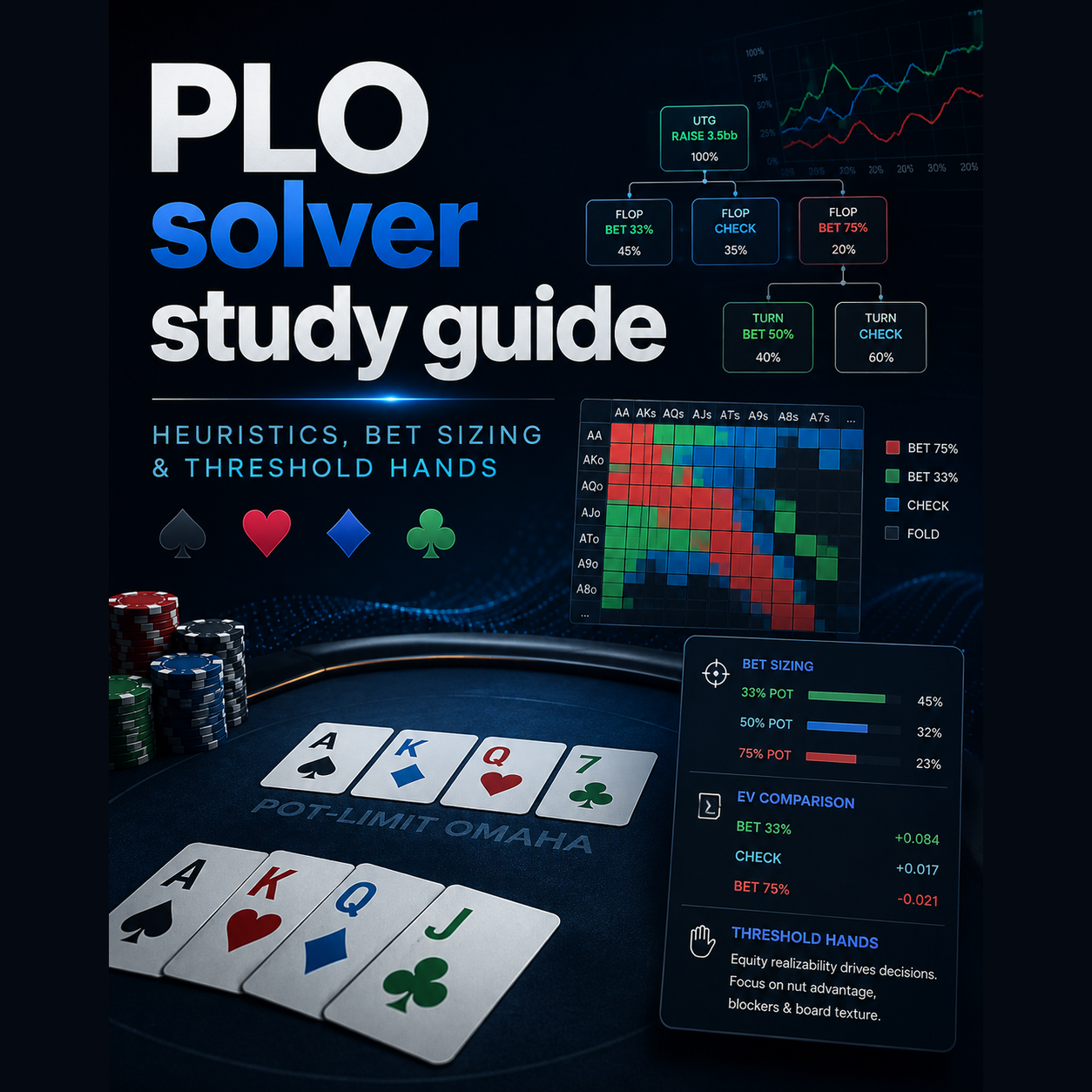
Once you understand those ranges, tools such as PLO Genius can help you study what happens after the flop. For flop textures and postflop decision practice, Flop Hero is another useful study option.
Why PLO Starting Hands Are So Different From Hold’em
In Hold’em, your two hole cards are the whole story. In PLO, you receive four cards but must use exactly two hole cards together with exactly three community cards.
That single rule changes everything.
- Strong hands make powerful draws more often.
- Strong hands make the nuts more often.
- Strong hands retain backup redraws.
- Strong hands have four cards that cooperate rather than conflict.
Connected, double-suited, high-card dense and capable of making many nut combinations.
Little coordination, poor high-card interaction and limited ability to make robust nut combinations.
Raw High Cards Are Not Enough
Omaha preflop strategy rewards structure. Premium hands usually combine several useful properties rather than relying on one attractive feature.
The Four Main Features of a Good PLO Hand
Connectivity
Cards close enough in rank to create wraps, straights and combo draws.
Suitedness
Meaningful suits that provide strong flush potential and redraws.
Nuttiness
The ability to make the best possible hand rather than dominated second-best holdings.
Pair + Side-Card Quality
Pairs become much stronger when the other cards supply suits, connectivity and redraws.
1. Connectivity: Cards That Work Together
Connectivity means your cards are close enough in rank to make wraps, straights and strong straight draws.
- A-K-Q-J is highly connected.
- K-Q-J-T is highly connected.
- A-K-7-2 is poorly connected.
Connected hands can flop open-enders, double-gutters, wraps, combo draws and strong semi-bluffs.
K♠ Q♠ J♦ T♦
This type of structure can make strong wraps, flush draws and high-card redraws across a wide range of board textures.
2. Suitedness: Not Just One Flush Suit
Suitedness matters, but having a suited ace does not automatically make the rest of a weak hand good.
A hand such as A♠ K♠ Q♦ J♦ benefits from two coordinated suits alongside excellent connectivity. A♠ 9♠ 7♦ 2♣ technically contains a suited ace but the overall hand remains poorly structured.
- Nut-flush potential
- Flush redraws
- Better board coverage
- Cleaner equity against other draws
Nut Flushes Matter More Than Weak Flushes
PLO creates many strong draws. Making the second- or third-best flush can become very expensive in large pots.
3. Nuttiness: Can This Hand Make the Nuts?
One of the most important beginner concepts is recognising that a hand is valuable not just because it can hit — but because it can make the best possible hand.
A♠ A♦ K♣ Q♥ can make top set and strong broadway combinations. Lower connected hands may make powerful straights, but can also run into domination on high boards.
Strong PLO starting hands generally retain nut potential on multiple kinds of runouts rather than depending on one perfect flop.
4. Pairs: Powerful Only When They Fit the Hand
A pair by itself is not automatically strong in Omaha.
A♠ A♦ K♣ Q♥ is excellent because the aces come with useful Broadway side cards. A♠ A♦ 7♣ 2♥ is much less attractive because the side cards provide fewer useful draws and redraws.
- Prefer pairs with connected side cards.
- Prefer useful suit coverage.
- Top-set potential is more valuable than vulnerable middle sets.
- Treat the pair as part of the whole four-card structure.
What Is a Dangler?
A dangler is the card that does not cooperate with the rest of your four-card hand.
A♠ K♠ Q♦ J♦
Every card contributes to connectivity, high-card strength or suit coverage.
A♠ K♠ Q♦ 3♣
The three contributes very little to the overall strength of the hand.
Four Working Cards Beat Three Good Cards + One Passenger
A hand containing a dangler can still be playable, but its overall quality falls because fewer two-card combinations work effectively with the board.
Why PLO Hand Evaluation Is Not Like NLHE
One of the most expensive beginner mistakes is evaluating Omaha holdings with a Hold’em mindset.
In NLHE, One Strong Made Hand Can Be Enough
Top pair/top kicker can be a major value hand in Hold’em. In PLO, top pair on its own frequently has to survive against much stronger drawing ranges.
In PLO, Your Hand Needs to Survive Multiple Streets
- Strong flop potential
- Turn improvement possibilities
- Nut potential on later streets
- Redraws when your first draw completes
Raw Equity Is Not the Whole Story
A hand can have reasonable raw equity yet realise it poorly because it makes dominated draws, weak made hands or difficult decisions.
What Happens After I Hit?
Do not just ask whether your hand can connect with the flop. Ask whether it connects in a way that can profitably continue against real ranges.
What Good PLO Starting Hands Usually Look Like
- Double-suited Broadway hands
- Connected rundowns
- Aces with strong side cards
- Wheel-connected hands with suits
- Hands with no obvious dangler and strong redraws
Double-Suited Broadways
Hands such as A♠ K♠ Q♦ J♦ and K♠ Q♠ J♦ T♦ combine high-card strength, connectivity and multiple meaningful suits.
Rundowns
Holdings such as T♠ 9♦ 8♣ 7♥ or 9♠ 8♠ 7♦ 6♦ connect with many flop textures and can produce large wrap draws.
Premium Aces
AAxx becomes much stronger when the side cards connect and provide meaningful suit coverage.
Wheel-Type Hands
Ace-low connected structures can create nut straights and nut flush opportunities, particularly when the cards are well suited.
A Simple Beginner Framework for PLO Hands
When you are learning PLO, you do not need to perfectly rank all 270,725 possible four-card combinations from memory.
Ask these questions instead:
- Are the cards connected?
- Do the suits work together?
- Can this hand make the nuts?
- Does it have a dangler?
- Does it retain redraws?
- Can it continue across several flop textures?
Stop Asking “Is This Hand Pretty?”
Ask how many strong flop types it can hit, how often its draws are nutted and how easily it can continue on turns and rivers.
Why Preflop Charts Matter So Much
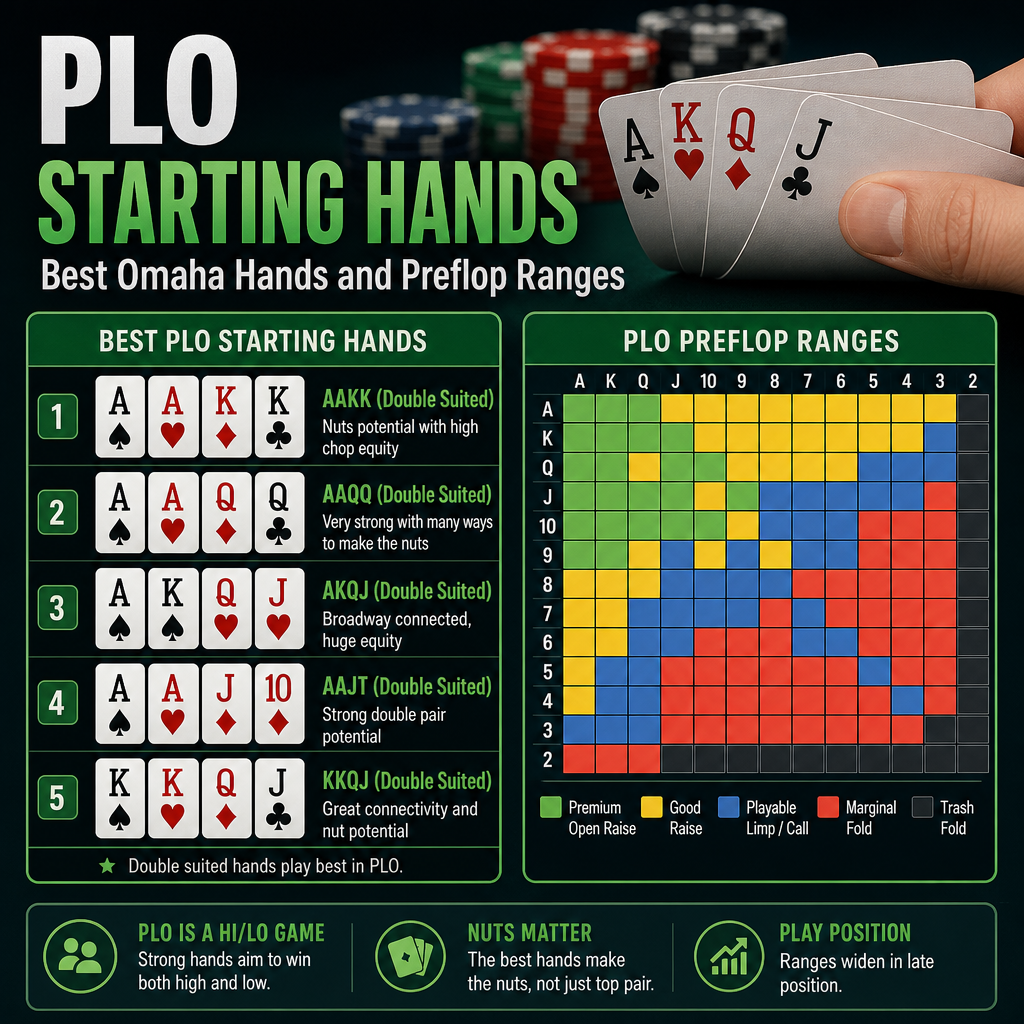
PLO hand construction is complicated enough that intuition alone is unreliable. That is where PLO GTO charts become valuable.
- Which hands to open
- How ranges change by position
- Which hands become folds
- How range structure shifts across seats and situations
Start With the Preflop Baseline
Use structured PLO ranges to learn which hand classes belong in your opening strategy. Then study how those hands perform postflop instead of trying to solve everything at once.
For additional background on Omaha rules, the Pagat Omaha rules reference is useful.
Common Beginner Mistakes With PLO Starting Hands
- Playing hands just because they contain aces
- Overvaluing one suit with no connectivity
- Ignoring danglers
- Calling with disconnected hands that make weak non-nut draws
- Playing “pretty” hands that are poorly coordinated
- Ignoring preflop charts as a baseline
Ask These Three Questions
If the hand misses, can it still continue? If it hits, is it likely to make the nuts? If it draws, is it drawing to the right side of the deck?
How to Study PLO Starting Hands Without Getting Overwhelmed
Trying to memorise every possible Omaha holding is inefficient. Learn hand classes first, then compare them against actual ranges.
Learn Premium Structures
Begin with double-suited broadways, strong rundowns and premium aces.
Learn Marginal Structures
Identify weak suits, gaps and danglers so you recognise why apparently attractive hands lose value.
Compare Against Charts
See where each hand class actually appears in your positional opening ranges.
Move Postflop
Study how those same starting hands perform across different boards and SPRs.
Take the Next Step Postflop
Once the preflop structure makes sense, use specialised tools to understand how those ranges behave after the flop.
Frequently Asked Questions About PLO Starting Hands
Are aces always the best PLO starting hands?
No. Aces are strong, but their quality depends heavily on the side cards, connectivity and suits. AA-KQ is generally far more useful than AA-72.
Are rundowns always good?
No. Connectivity is valuable, but suit quality, gaps and nut potential still matter. The strongest rundowns combine several favourable properties.
Why use charts if I can judge hand strength intuitively?
Intuition tends to overvalue attractive-looking hands. Charts show how complete ranges are actually structured by position.
What is the biggest beginner mistake?
Playing too many hands that make weak non-nut draws. Strong PLO hands should be able to continue with robust equity while retaining nut potential.
Good PLO Hands Are Strong Combinations
The biggest lesson in PLO starting hands is simple: four good-looking cards are not enough. Connectivity, suitedness, nuttiness, redraws and the absence of a bad dangler all work together to determine whether a hand is genuinely strong.
Learn the structures first, use charts to build your preflop baseline, then move into postflop study.