Poker Squeeze Strategy How to Call, 4-Bet or Fold When You Get Squeezed
Facing a squeeze is one of the easiest preflop spots to misplay because the pot is already large, ranges are position-dependent and your original action does not tell the whole story. The right response can include folds, calls, small 4-bets and all-ins — often at mixed frequencies.
What Is a Squeeze in Poker?
A squeeze occurs when one player raises, at least one player calls, and a player behind makes a re-raise. The extra caller creates dead money in the pot, so the squeezer can often 3-bet more aggressively than they would against the original raiser alone.
The original raiser is now caught between the caller and the squeezer. That creates difficult decisions because calling may invite the original caller into a multiway 3-bet pot, while 4-betting commits substantially more chips.
A squeeze is not simply “raising because you have a strong hand.” Strong players can squeeze for value and as a bluff because the extra dead money improves the reward for forcing folds.
What Determines Your Response to a Squeeze?
- Your position: Will you be in position or out of position against the squeezer?
- The opener’s range: UTG opens are much stronger than BTN opens.
- The caller’s range: A cold caller can block or contain some strong hands and changes the dead-money calculation.
- Squeezer position: BTN and BB squeezes create very different postflop situations.
- Squeeze size: Large sizes reduce the attractiveness of calling.
- Stack depth: 40BB, 100BB and 200BB ranges can be radically different.
- Rake: Calling ranges in cash games are highly rake-sensitive.
When You Are Squeezed Out of Position
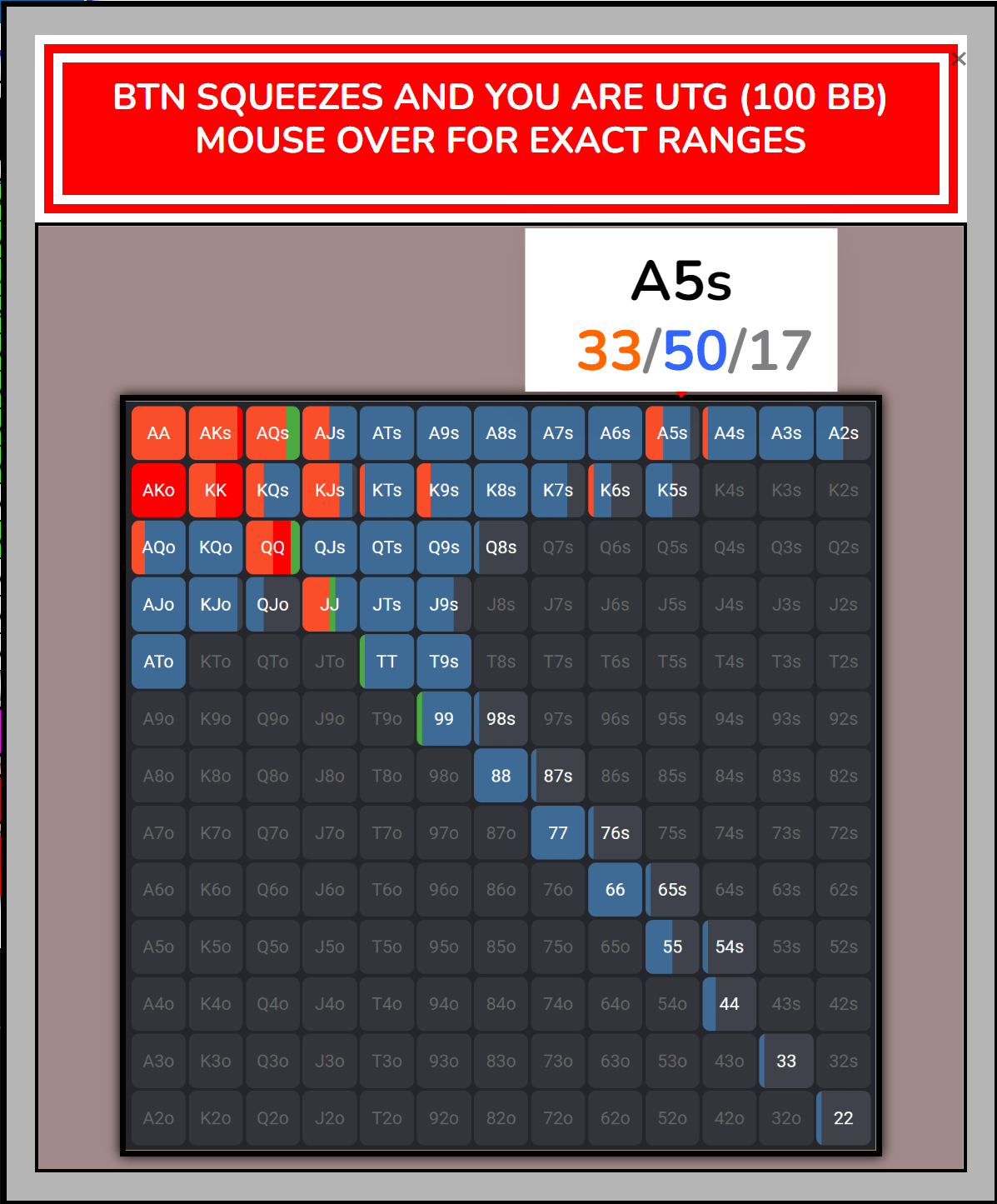
Out of position, calling is less attractive because equity realisation becomes harder and the caller behind may still enter. This often pushes more of the continuing range toward a clean 4-bet-or-fold structure, although the exact solution depends on positions, size and stack depth.
Your old chart example — UTG facing a BTN squeeze — correctly illustrates an important point: not every premium-looking hand must always shove, and some suited wheel aces can appear as mixed 4-bets because they block strong continuing hands and retain reasonable equity when called.
However, exact frequencies such as “A5s 4-bets 33%” should only be used with the specific chart assumptions that produced them. Change the open size, cold caller, squeeze size, rake or stack depth and the mix can change.
When You Are Squeezed In Position
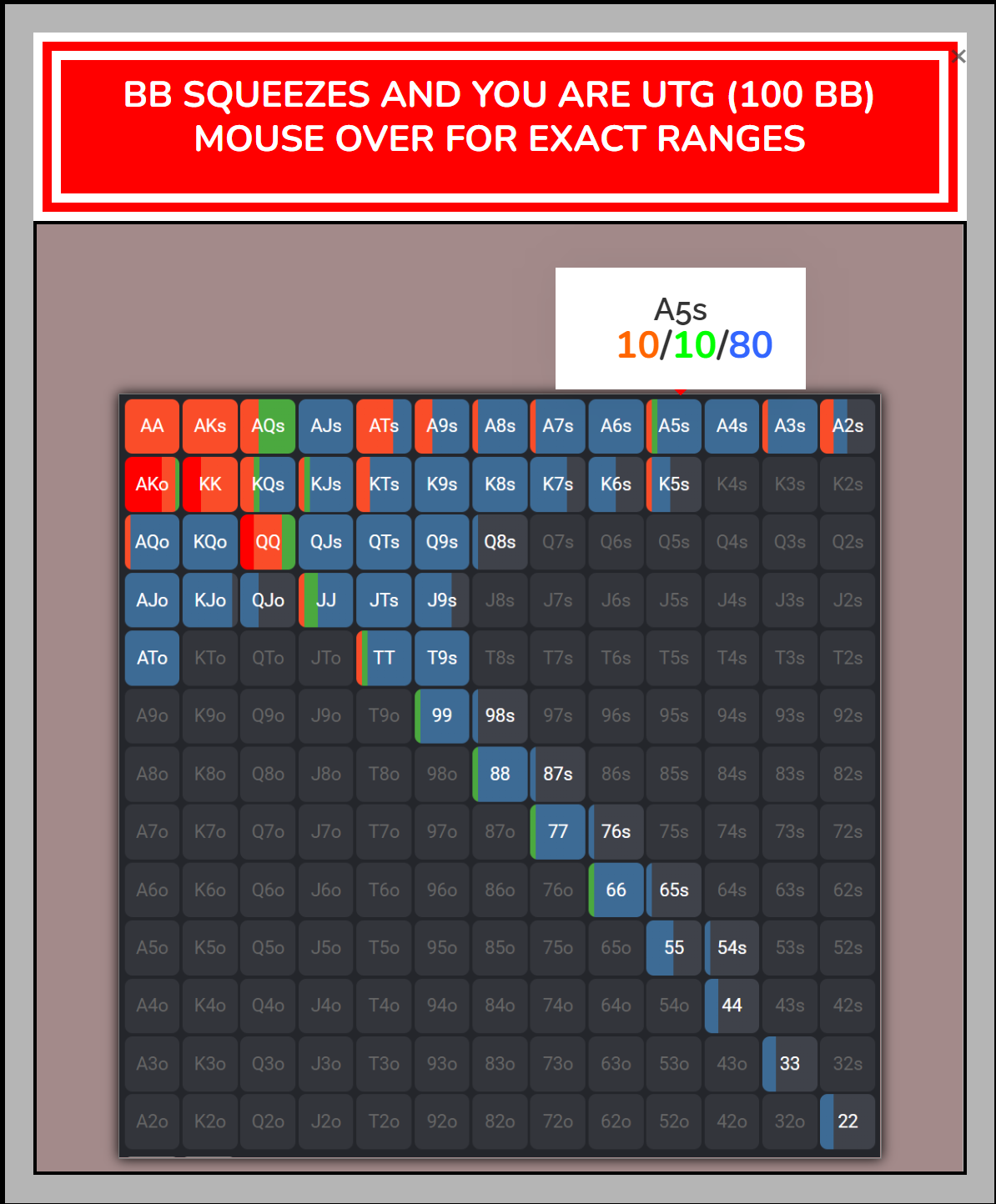
Having position against the squeezer improves equity realisation and can preserve more calls. In your original UTG-versus-BB example, some hands that were pure folds in the OOP configuration were allowed to call at low frequency when they could play the rest of the hand in position.
That does not mean “call all medium pairs because you have position.” The squeezer’s range is strong, SPR is reduced and reverse implied odds matter. The correct lesson is that position changes the shape of the continuing range.
Call, 4-Bet or Fold? A Practical Framework
| Action | Typical Reason |
|---|---|
| 4-bet for value | Strong hands that perform well against the squeezer’s continue range. |
| 4-bet bluff / mix | Hands with useful blockers and acceptable equity that prefer fold equity to calling. |
| Call | Hands with enough equity and realisation, especially when position and price are favourable. |
| Fold | Hands that opened profitably but cannot continue against the stronger squeeze range and price. |
| Jam | More common at shorter effective stacks or in configurations where a non-all-in 4-bet leaves awkward SPR. |
How to Use Mixed Frequencies
Old GTO charts often show hands split between actions: perhaps 4-bet 30%, call 20% and fold 50%. You do not need to “feel” when the 30% happens. A random number generator can execute the mix: if your convention is 1–100, take the 4-bet when the RNG lands inside the assigned interval.
But do not let RNG distract you from the bigger lesson. A mixed strategy usually means the EVs of several actions are close. If your opponent has a strong exploitative tendency — for example, squeezing far too wide or folding too much to 4-bets — a deliberate deviation may be better than rigidly preserving the equilibrium mix.
That baseline-to-exploit process is covered in our GTO vs Exploitative Poker guide.
Common Squeeze Mistakes
- Overfolding because the pot feels scary. Some ranges must defend meaningfully against aggressive squeeze frequencies.
- Calling too much OOP. Attractive-looking suited hands can lose value quickly when squeezed and forced to realise equity out of position.
- 4-betting only premiums. Against observant opponents this makes the range transparent.
- Using one squeeze chart for every game. Stack depth, rake, open size and caller positions matter.
- Ignoring the cold caller. Their range changes both blocker effects and the probability that the pot goes multiway.
How to Study Squeeze Spots in 2026
Static charts remain excellent for fast reference because squeeze trees are difficult to recall in real time. Use our preflop chart guide and free chart library to build the basics.
For unusual squeeze sizes, different stack depths or custom preflop trees, a solver is more flexible. GTO Wizard AI now supports custom preflop solving, including complex multiway configurations, so it is useful when your actual game does not match a fixed chart.
Stop Guessing When the Pot Gets Squeezed
Use GTOCharts for fast preflop reference and GTO Wizard when you need a custom range, stack depth, squeeze size or multiway preflop configuration.
Browse Free GTO Charts Solve with GTO Wizard