Poker Solvers Explained How GTO Solvers Work & How to Study Them
Poker solvers have moved from specialist desktop software into fast browser-based study platforms. The important skill in 2026 is no longer simply knowing that a solver exists — it is knowing what question to ask, how to read the output, and how to turn a complicated mixed strategy into something you can actually use at the table.
In This Guide
What Is a Poker Solver?
A poker solver is software that models a poker situation as a strategic game and searches for an equilibrium strategy. In practical terms, you tell the solver who is in the hand, the stack depth, the ranges, the board, the pot size and the actions that are allowed. The solver then calculates how often each hand should bet, check, call, raise or fold.
The result is not usually a single instruction such as “always bet.” Many hands are mixed between actions because several choices can have similar expected value. A hand may bet 70% of the time and check 30%, while a neighbouring hand behaves very differently because of blockers, equity or how it interacts with the opponent’s range.
This is why solver study is more useful when you look for patterns rather than memorising thousands of frequencies. If you understand why a range bets small on one board, checks heavily on another, and uses a polar overbet on a third, you can recreate much of the strategy without remembering every combo.
How Poker Solvers Work
Traditional solvers repeatedly play the game tree against themselves, improving each player’s strategy until the remaining exploitability becomes very small. Modern AI-assisted solvers can accelerate parts of that process with predictive models, but the strategic objective is similar: approximate a Nash equilibrium for the specified game.
A solver evaluates the expected value of each legal action. If betting a certain hand too often allows the opponent to profitably raise, the strategy adjusts. If the opponent folds too often, bluffs gain value. Through repeated iteration, the two strategies move toward a point where simple unilateral adjustments no longer generate meaningful extra EV.
Change the rake, stack depth, preflop ranges or available bet sizes and the solution can change. A solver is not revealing a universal poker law; it is answering the specific game tree you gave it.
What Information Does a Solver Need?
| Input | Why It Matters |
|---|---|
| Player ranges | The entire postflop strategy depends on which combinations can reach the node. |
| Effective stack | Stack depth changes SPR, raise sizes, all-in thresholds and the value of draws. |
| Rake / ante | Especially important preflop and in lower-stakes cash games. |
| Board / runout | Determines range advantage, nut advantage, blockers and equity distribution. |
| Bet sizes | Restricting the tree can simplify study but may hide strategically useful sizes. |
| Game format | Cash, MTT, Spins, heads-up and ICM situations require different assumptions. |
Why Solver Study Improves Your Poker Game
1. It gives you a reliable baseline
Without a baseline, it is easy to label any aggressive line “good” or any tight fold “disciplined.” Solver output gives you a reference point for how ranges should interact before you make exploitative adjustments.
2. It exposes hidden leaks
Many leaks are not obvious from results alone. You may be winning with a hand class but still losing EV because you call too much, miss profitable raises, or use the wrong sizing. Hand-history analysis and GTO reports are useful because they can aggregate those mistakes rather than forcing you to inspect one hand at a time.
3. It teaches range-versus-range thinking
The strongest lesson from solver study is usually not “bet this exact hand.” It is understanding which player owns more strong hands, which player has more nut combinations, and how that changes the betting architecture of the whole range.
4. It improves bet sizing
Many players choose sizes by habit. Solver work shows that small bets, large bets and overbets each solve different strategic problems. You learn when your range wants to bet frequently for a small size and when it prefers a polar strategy with fewer, larger bets.
Common Poker Solver Mistakes
- Copying frequencies without understanding the reason. Memorising 63% instead of learning the board-class pattern rarely survives real play.
- Using the wrong ranges. A perfect postflop solution built from unrealistic preflop ranges is answering the wrong question.
- Studying exotic spots first. BTN vs BB single-raised pots and common 3-bet pots usually deserve more attention than rare river nodes.
- Treating GTO as the finish line. If a population clearly overfolds, underbluffs or calls too much, the highest-EV practical strategy can deviate.
- Ignoring rake and stack depth. Preflop ranges are particularly sensitive to both.
- Trying to memorise everything. Simplified heuristics, board buckets and repeated drills are more useful than raw output dumps.
A Practical Solver Study Workflow
- Start with one common spot. Example: BTN opens, BB calls, 100BB cash.
- Compare several flop families. Ace-high dry, paired, low connected and monotone boards.
- Record the pattern. Note sizing, overall frequency, value region and natural bluffs.
- Drill the spot. Use a trainer until the broad decisions become automatic.
- Review your real hands. Look for repeated deviations, not one-off mistakes.
- Add an exploit layer. Once the baseline is clear, ask how a known population tendency should change it.
If you are new to solver study, also read our beginner guide to poker preflop charts and browse the free GTO charts before diving into highly complex trees.
Which Poker Solver Should You Use in 2026?
There is no single perfect tool for every player. Dedicated technical solvers still appeal to players who want maximum tree control, while browser platforms are far easier for everyday study. Our current GTO solver comparison and Best Poker Software 2026 guide compare the main options.
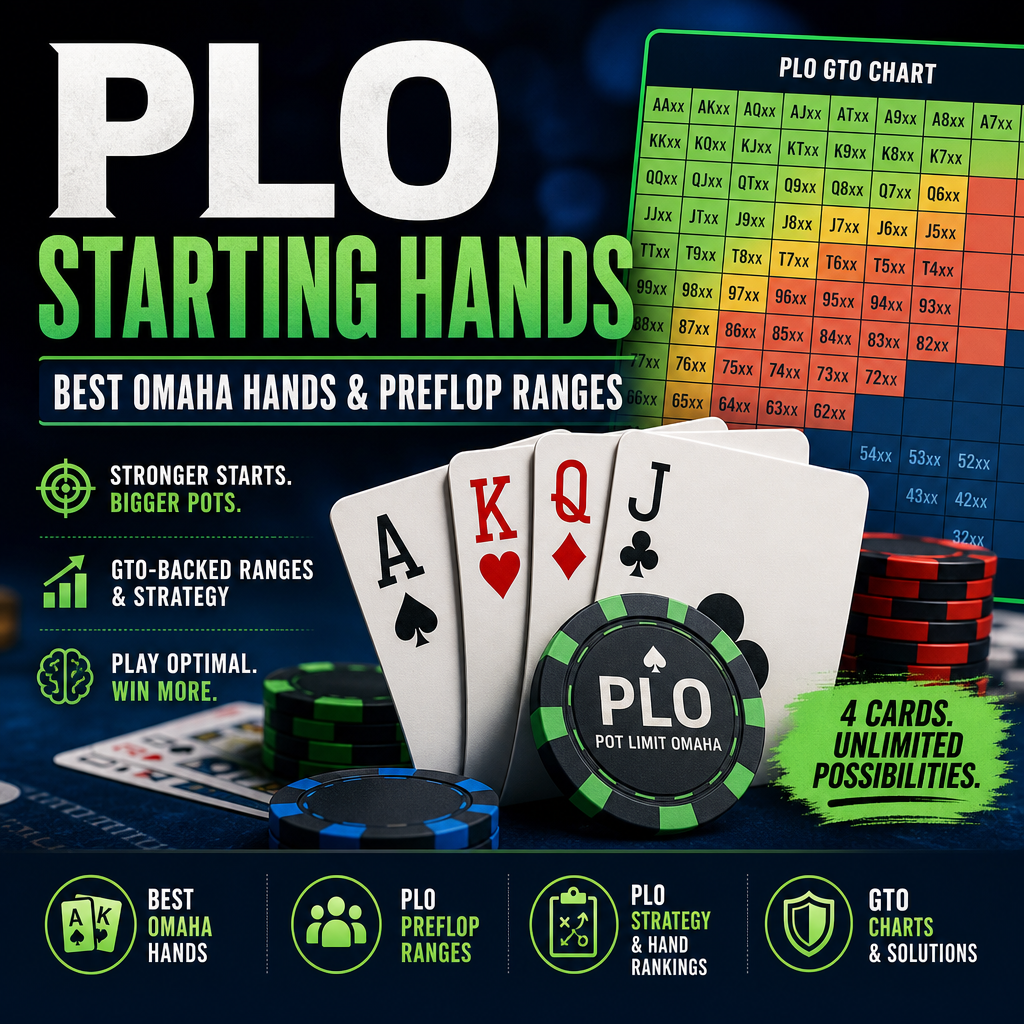
For most players who want one connected workflow, GTO Wizard is our preferred all-round option. In 2026 it combines a large solution library, GTO Wizard AI custom solving, drills, hand-history analysis, GTO Reports and aggregated flop reports in a browser-based platform. It covers major Hold'em formats and now also supports PLO study.
For players who want to see how the reporting side has evolved, see our GTO Reports overview.
Study Solver Strategy Without Building Trees From Scratch
GTO Wizard is the easiest starting point for players who want pre-solved ranges, custom solving, drills and hand-history analysis in one place.
Explore GTO Wizard Compare Poker Solvers